Starting yoga is easy. Staying consistent is where most people fall apart. This guide covers how to structure a real yoga practice, what to prioritize at each stage, and how to avoid the common traps that make people quit within the first month.
How Long Your Sessions Need to Be
There is a persistent myth that yoga only counts if it lasts 60 to 90 minutes. Research does not support this.
A 2023 study published in the International Journal of Yoga found that sessions as short as 20 minutes, performed 4 to 5 days per week, produced measurable improvements in flexibility, perceived stress, and balance within 8 weeks, comparable to longer sessions done twice weekly.
Practical session targets by experience level:
- Weeks 1 to 4: 20 to 30 minutes, 3 to 4 times per week
- Months 2 to 3: 30 to 45 minutes, 4 times per week
- Month 4 onward: 45 to 60 minutes, 4 to 5 times per week, with one Yin or Restorative session
Shorter sessions done consistently build more than occasional long sessions.
A Beginner Yoga Plan: First 4 Weeks
The goal in the first month is not flexibility. It is learning to feel your body in unfamiliar positions without compensating.
Week 1 to 2: Foundations
Focus on standing and seated poses. Learn to breathe during discomfort instead of holding your breath.
Core poses to practice:
- Mountain Pose (Tadasana) - posture reference point
- Cat-Cow (Marjaryasana-Bitilasana) - spinal mobility
- Downward Dog (Adho Mukha Svanasana) - hamstrings, shoulders, posterior chain
- Child's Pose (Balasana) - rest and hip opener
- Warrior I and II - hip flexors, stability
- Seated Forward Fold (Paschimottanasana) - hamstring assessment
Week 3 to 4: Adding Load and Hold Times
Extend hold times from 3 breaths to 5 to 8 breaths per pose. Introduce:
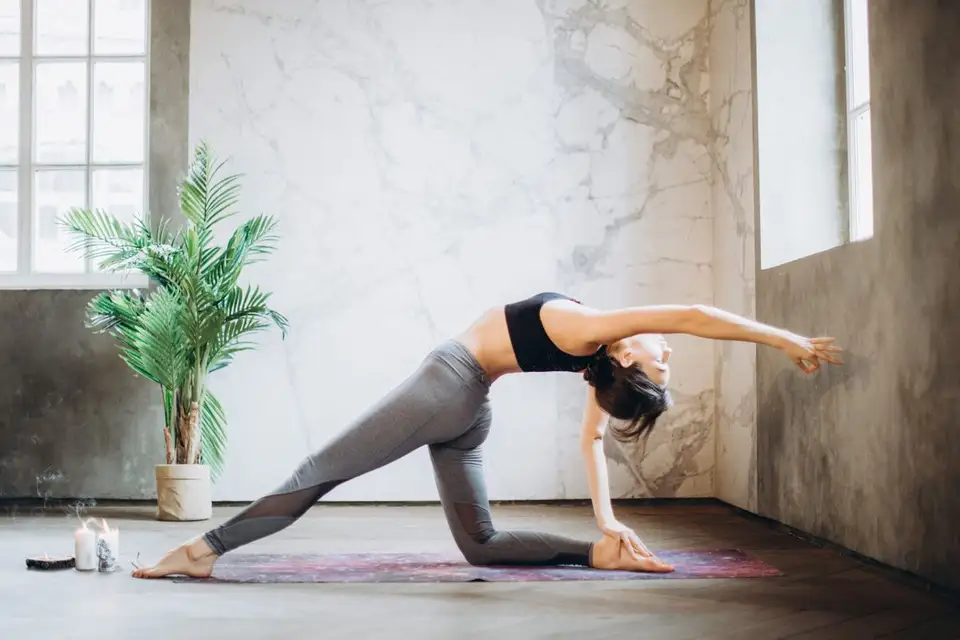
- Low Lunge (Anjaneyasana) - hip flexor depth
- Triangle Pose (Trikonasana) - lateral chain stretch
- Bridge Pose (Setu Bandhasana) - glute activation, spine extension
- Supine Twist - spinal decompression
Do not chase depth. A 20 percent range of motion with correct muscle activation is more productive than 80 percent with passive collapsing.
Intermediate Yoga: Months 2 Through 6
Once foundational poses feel stable, training shifts toward transitions, balance, and strength under length.
What changes at the intermediate stage:
- Hold times increase to 8 to 10 breaths
- Standing balance poses are introduced (Warrior III, Half Moon)
- Arm balances begin with Crow Pose (Bakasana) prep work
- Sun Salutations become the warm-up rather than the workout
Sample intermediate weekly structure:
| Day | Style | Duration | Focus |
|---|---|---|---|
| Monday | Vinyasa | 45 min | Strength, flow |
| Tuesday | Yin | 30 min | Hip and hamstring depth |
| Wednesday | Rest or walk | - | Recovery |
| Thursday | Hatha | 45 min | Alignment refinement |
| Friday | Power Yoga | 50 min | Endurance |
| Saturday | Restorative | 30 min | Nervous system reset |
| Sunday | Rest | - | Full recovery |
The Role of Breathwork in Yoga Practice
Breath is not decoration. Pranayama, the formal term for yogic breathwork, directly regulates the autonomic nervous system and affects how your body tolerates holds and transitions.
The three techniques worth learning early:
Ujjayi breath: Slight constriction at the back of the throat creates a soft audible breath. This slows respiration, increases interoceptive focus, and stabilizes the nervous system during challenging poses. Most Vinyasa classes use it throughout.
Box breathing (4-4-4-4): Inhale 4 counts, hold 4, exhale 4, hold 4. Useful before practice to reduce cortisol and mental chatter. Takes 5 minutes. Measurably lowers heart rate variability markers associated with stress.
Nadi Shodhana (alternate nostril breathing): Alternates breath between left and right nostrils. Used post-practice for recovery. Studies suggest it balances sympathetic and parasympathetic tone, which matters if you are pairing yoga with intense gym training.
Pairing Yoga with Strength Training or HIIT
Yoga and resistance training are not competing modalities. They address different physical qualities. The issue is sequencing.
Rules for combining yoga with gym work:
- Do not do deep Yin yoga before heavy lifts. Prolonged passive stretching reduces force production for up to 30 minutes.
- Vinyasa or Power Yoga works as a warm-up before moderate training sessions.
- Yin and Restorative yoga is highly effective on rest days from strength training. It accelerates soft tissue recovery.
- Yoga on the same day as leg day should target upper body and spine, not hamstrings.
A practical split for someone training 4 days per week in the gym:
- Gym days: 15-minute Vinyasa warm-up, not yin
- Off days: 30 to 40-minute Yin or Hatha session
- One full Restorative session per week regardless of training volume
Common Technique Mistakes That Limit Progress
Most plateaus in yoga come from the same repeated errors.
Hyperextending in Downward Dog: People dump into their lower back instead of pushing the floor away and lengthening the spine. Bend the knees slightly and focus on hip elevation, not heel grounding.
Collapsed arches in Warrior poses: The front foot pronates inward, which collapses the knee. Press the big toe mound into the mat and engage the arch actively.
Breathing out of sync with movement: In Vinyasa, inhales accompany lengthening or opening movements, exhales accompany folding or compressing. Reversing this creates unnecessary tension.
Forcing depth before earning it: Passive flexibility gains without stability create joint vulnerability. Every degree of range gained should have active muscular control within it.
Skipping Savasana: The final resting pose is not optional relaxation. Research shows that 5 to 10 minutes of Savasana after practice significantly improves the consolidation of motor learning and reduces cortisol more than ending practice abruptly.
Equipment You Actually Need
Yoga does not require significant investment, but a few items directly affect technique quality.
| Item | Why It Matters | Budget Option | Upgrade Option |
|---|---|---|---|
| Yoga mat | Grip, cushioning, spatial awareness | 6mm PVC mat (~$20) | Natural rubber mat, 4mm (~$80-120) |
| Yoga blocks (2) | Allows correct alignment when flexibility is limited | Foam blocks (~$10-15 pair) | Cork blocks (~$30 pair) |
| Yoga strap | Extends reach in forward folds, assists binds | Nylon strap (~$10) | Cotton strap with metal buckle (~$18) |
| Bolster | Supports restorative and Yin poses | Rolled blanket | Rectangular bolster (~$40-60) |
A non-slip mat is the single most impactful equipment investment. Moving hands during Downward Dog or sliding feet in Warrior II breaks concentration and limits strength development.
How to Measure Progress in Yoga
Progress in yoga is not linear and does not track the same way gym progress does. Useful markers:
- Breath quality: Can you maintain Ujjayi through a challenging hold? If yes, your nervous system adaptation is working.
- Recovery after sessions: Less soreness week over week in the same sequence indicates tissue adaptation.
- Hold duration: Tracking breath counts per pose over months shows real improvement.
- Transition fluency: In Vinyasa, smooth Chaturanga to Upward Dog to Downward Dog transitions indicate shoulder, core, and hip strength development.
- Off-mat markers: Better posture at a desk, reduced lower back tightness, improved sleep quality. These appear within 4 to 6 weeks of consistent practice.